
BIOGAS

Generating Energy From Waste
With world resources finite, and increasing public awareness of the harmful effects of our ‘throwaway culture’, a move towards what’s known as a circular economy seems a sensible option. In short, this means making products last longer, and recovering materials or other benefits from them when they can’t be fixed. Generating energy from waste – whether that’s electricity or heat – that can then be used in homes and businesses is a logical part of this move towards circular thinking.
How waste-to-enegery plants work
Waste-to-energy plants burn municipal solid waste (MSW), often called garbage or trash, to produce steam in a boiler that is used to generate electricity.
There are different types of waste-to-energy systems or technologies. The most common type is the mass-burn system, where unprocessed MSW is burned in a large incinerator with a boiler and a generator for producing electricity (see illustration below). Another less common type of system processes MSW into fuel pellets that can be used in smaller power plants.
The process of generating electricity in a mass-burn waste-to-energy plant has seven stages: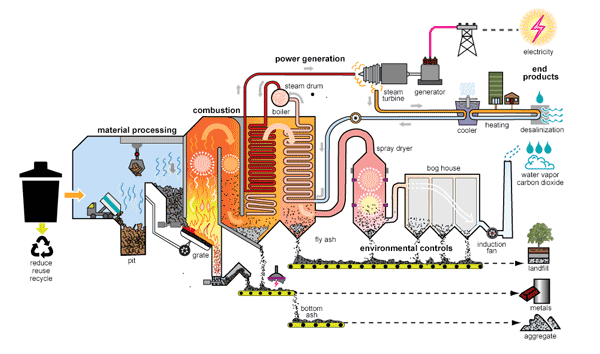
- Waste is dumped from garbage trucks into a large pit.
- A giant claw on a crane grabs waste and dumps it in a combustion chamber.
- The waste (fuel) is burned, releasing heat.
- The heat turns water into steam in a boiler.
- The high-pressure steam turns the blades of a turbine generator to produce electricity.
- An air pollution control system removes pollutants from the combustion gas before it is released through a smoke stack.
- Ash is collected from the boiler and the air pollution control system.
- MSW is a mixture of energy-rich materials such as paper, plastics, yard waste, and products made from wood.
Waste-to-energy around the world
Many countries use waste-to-energy plants to capture the energy in MSW. The use of waste-to-energy plants in some European countries and in Japan is relatively high, in part because those countries have little open space for landfills.