
WIND ELECTRIC

Electricity from Wind Energy
The Earth is surrounded by the atmosphere, which is made up of air. Air is a mixture of gas, and solid and liquid particles. Energy from the sun heats up the atmosphere and the Earth unevenly.
Cold air contains more air particles than warm air. Cold air is therefore heavier and sinks down through the atmosphere, creating high pressure areas. Warm air rises through the atmosphere, creating low pressure areas. The air tries to balance out the low and high pressure areas – air particles move from areas of high pressure (cold air) to areas of low pressure (warm air). This movement of air is known as the wind.
The wind is also influenced by the movement of the earth. As it turns on its axis the air does not travel directly from areas of higher pressure to areas of lower pressure. Instead, the air is pushed to the west in the northern hemisphere and to the east in the southern hemisphere. This is known as the Coriolis force.
The Earth's surface is marked with trees, buildings, lakes, sea, hills and valleys, all of which also influence the wind's direction and speed. For example, where warm land and cool sea meet, the difference in temperature creates thermal effects, which causes local sea breezes.
What is Wind Tribune ?
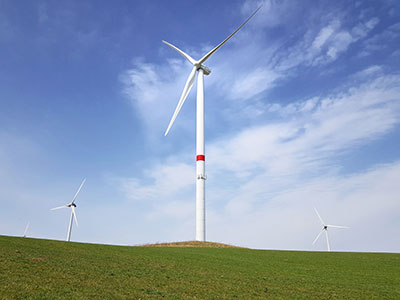
A wind turbine is a machine that transforms the kinetic energy of the wind into mechanical or electrical energy. Wind turbines consist of a foundation, a tower, a nacelle and a rotor. The foundation prevents the turbine from falling over. The tower holds up the rotor and a nacelle (or box).
The nacelle contains large primary components such as the main axle, gearbox, generator, transformer and control system. The rotor is made of the blades and the hub, which holds them in position as they turn. Most commercial wind turbines have three rotor blades. The length of the blades can be more than 60 metres.
 How much Electricity is created from wind in Europe ?
The total installed wind power capacity in Europe at the end of 2012 covers 7% of the EU-27’s electricity demand. By 2020, EWEA estimates that 230 GW (including 40 GW offshore) of wind power capacity will be installed in the EU, meeting 15-17% of the EU’s electricity demand (4.2% from offshore). By 2050, EWEA estimates that wind power will meet 50% of the EU’s electricity demand. Wind provides 26% of electricity in Denmark, while Portugal and Spain get around16% of electricity from wind power respectively, followed by Ireland (12%) and Germany (11%).
What are a turbine’s lifetime emission ?
Wind turbines produce no greenhouse gas emissions during their operation. It takes a turbine just three to six months to produce the amount of energy that goes into its manufacture, installation, operation, maintenance and decommissioning after its 20-25 year lifetime. During its lifetime a wind turbine delivers up to 80 times more energy than is used in its production, maintenance and scrapping. Wind energy has the lowest ‘lifecycle emissions’ of all energy production technologies.
What other environmental benefits does wind power bring ?
Wind energy emits no toxic substances such as mercury and air pollutants like smog-creating nitrogen oxides, acid rain-forming sulphur dioxide and particulate deposits. These pollutants can trigger cancer, heart disease, asthma and other respiratory diseases, can acidify terrestrial and aquatic ecosystems, and corrode buildings.Wind energy creates no waste or water pollution. Unlike fossil fuel and nuclear power plants, wind technology uses very little water to produce electricity. Given the fact that water scarcity is pressing and will be exacerbated by climate change and population growth, wind energy is key to preserving water resources.
Do wind turbines harm human health ?
The noise of wind turbines has been reduced significantly. Improved design has drastically reduced the noise of mechanical components so that the most audible sound is that of the wind interacting with the rotor blades. This is similar to a light swishing sound, and much quieter than other types of modern-day equipment. Even in generally quiet rural areas, the sound of the blowing wind is often louder than the turbines.
Wind energy is one of the cleanest, most environmentally-friendly energy sources. It emits no greenhouse gases or air pollutants. It emits no particles, unlike fossil fuels, which are carcinogenic and severely affect human health.
A study, Wind Turbine Sound and Health Effects, was conducted in 2009 by a panel of medical professionals from the US, Canada, Denmark, and UK. The study concluded, “There is no evidence that the audible or sub-audible sounds [including infrasound] emitted by wind turbines have any direct adverse physiological effects.”
The Australian government and the National Health and Medical Research Council (NHMRC) conducted a study on ‘Wind Turbines and Health’ (2010) which concluded:‘There are no direct pathological effects from wind farms […] any potential impact on humans can be minimised by following existing planning guidelines’.
Wind power energy and economy
- Wind energy contributed €32 billion to the EU economy in 2010 and as of 2012, 250,000 people in Europe had a job linked to wind energy - by 2020, the sector will have generated 520,000 jobs.
- Between 2001 and 2010 the wind energy sector increased its contribution to GDP by 33%, ever as overall GDP growth slowed. Between 2001 and 2010, jobs in wind energy went up by 30% while EU unemployment rose by 9.6%.
- The EU wind energy sector was a net exporter of € 5.7 billion worth of products and services in 2010. The EU accounted for 37.5% of the global wind energy market in 2012.
- Wind energy makes Europe less dependent on fuel imports at unpredictable prices - in 2012, wind power production in Europe avoided fuel costs of €9.6 billion. This will rise to €22 -27 billion in 2020 and €47-51 billion in 2030.
- Wind-generated power comes at a zero fuel cost and zero CO2 cost, unlike most traditional energy sources. Wind power can also lower electricity prices and bring more competition to the market.